
digital-safety
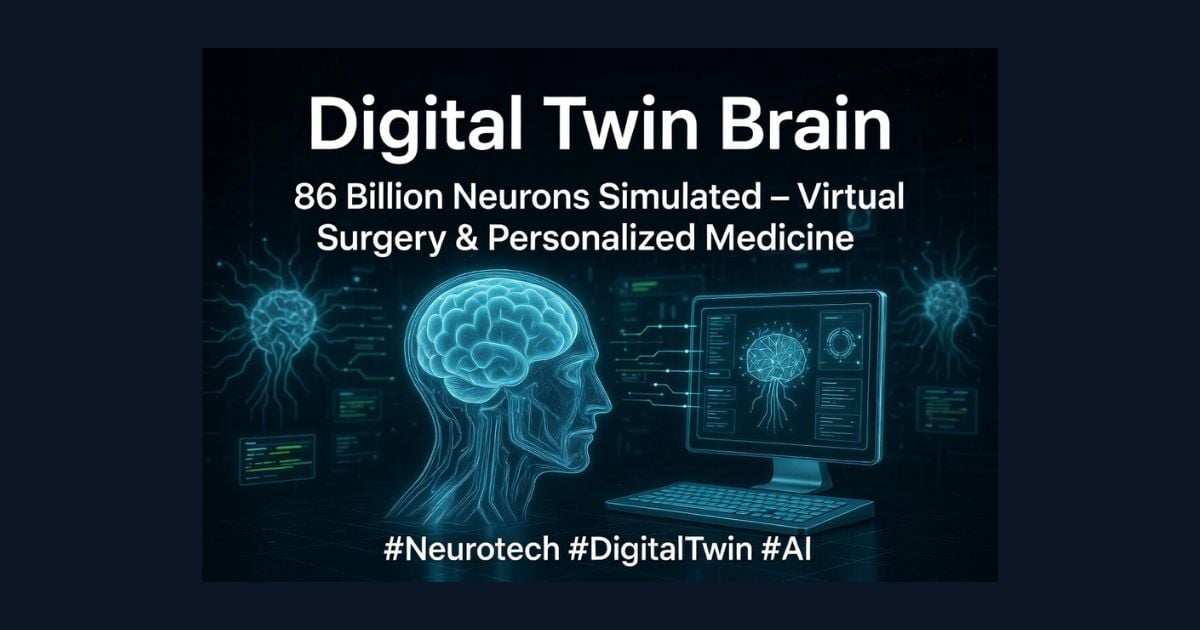

Digital Twin Brain is basically a computer "twin" of the human brain: a large model that tries to mimic how the brain behaves. It might sound like science fiction, but the idea is actually very down-to-earth.
Digital twin means digital twin, a computer model of some real system (like a factory, engine, or in this case, the brain) that lets you test scenarios "in simulation" first, before touching the real thing.
Brain is the organ that creates our thoughts, emotions, memories, and everything we experience as "me."
In the Fudan project, researchers tried to create a digital model that numerically matches the human brain: about 86 billion cells called neurons (nerve cells that process electrical and chemical signals) and a massive network of connections between them.
When it says the model reproduces BOLD signals, it means it tries to imitate what doctors see on functional magnetic resonance imaging (fMRI) – changes in blood flow and oxygen levels in specific brain areas while we think, sleep, or perform tasks. BOLD stands for Blood-Oxygen-Level Dependent, so the signal "depends on blood oxygen levels."
Digital Twin Brain is a very sophisticated simulator, but still "just" a simulator.
It can, for example:
"Run" the virtual brain in resting state and see what activity patterns it creates – like scanning someone's brain while they lie relaxed with eyes closed.
Set it to different "states" – wakefulness, light anesthesia, deep anesthesia – and watch how the signal patterns change.
Insert data about a specific patient's real anatomy (brain scans), so the model is no longer an "average brain" but approximately "your brain on a computer."
This opens the possibility to test surgery in simulation first: plan where it's safe to "cut" and where there's risk of damaging speech or movement. Similar concepts already exist in virtual neurosurgery – surgeons train on computer simulators, which has proven helpful by reducing errors in real operations.
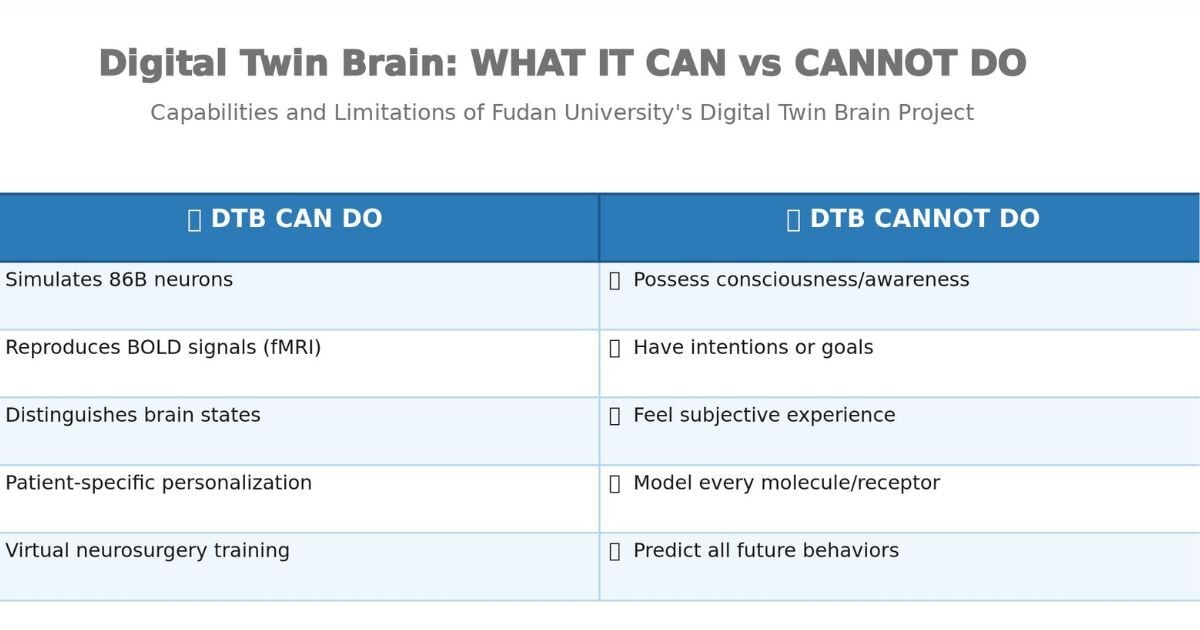
Digital Twin Brain has no consciousness – no inner sense of self, doesn't feel pain, doesn't "know" it exists.
Two levels are often confused:
Neural correlates of consciousness – activity patterns we see when someone is awake, dreaming, or under anesthesia (what instruments measure).
Phenomenal consciousness – that subjective "what it's like to be me, right now," which we can't directly read from graphs or scans.
DTB targets the first: it tries to faithfully imitate activity patterns. The second, inner experience, remains tied to the living brain, body, and life history – and that's still seriously debated in philosophy and cognitive science.
Also, the model isn't "the whole brain down to the last molecule." It doesn't capture, for example:
all details at the molecular level (e.g., exactly how each drug binds to a specific receptor)
the role of support tissue (glial cells, inflammatory processes, blood-brain barrier)
long-term plasticity – how the brain changes its connections over years of learning and experience
That's why we should beware of exaggerated claims: DTB is a powerful tool, but not a crystal ball that knows everything about our behavior or fate.
China has been heavily investing in non-human primate (monkey) research for years and before the pandemic supplied over 60% of research animals to Western labs.
It has more state centers for primate research than the US, meaning greater capacity for long-term and complex experiments.
As part of the China Brain Project, there's talk of the "One Body, Two Wings" structure – one "body" (basic brain research) and two "wings": treating neurological diseases and developing brain-inspired artificial intelligence.
Talk of cognitive warfare is becoming more frequent. It's the idea that battles are no longer fought just with tanks and planes, but by influencing perception, emotions, and decisions: through propaganda, social media, targeted disinformation, and techniques using brain knowledge. Such scenarios are currently speculative and belong to serious ethical debate, not descriptions of existing programs.
👉The Future of Neuro‑Robotics: Technical Review
.jpg?width=2400&height=1600&name=spectrum_chart%20(1).jpg)
Already today there are very concrete ethical questions:
Who owns data about your brain and who can access it?
Has the patient really understood what it means to have "their brain simulated" before signing consent?
How to prevent medical data and models from being used for manipulation or discrimination (e.g., in hiring, insurance, politics)?
There are also speculative but useful as "stress-tests":
Could one day behavior of individuals be predicted from simulation with dangerously high accuracy?
Could a combination of BCI and models lead to thought surveillance?
The second group of questions is not a description of today's reality, but serves to design laws and ethical frameworks in time – so technology doesn't catch us unprepared.
Lu, H. et al. (2022). Simulation and assimilation of the digital human brain. arXiv.
https://arxiv.org/abs/2211.15963
Huang, C.-C. et al. (2023). Digital Twin Brain: a simulation and assimilation platform for whole human brain,
https://arxiv.org/abs/2308.01241
Gao, J. et al. (2022). Progress of the China brain project. PMC.
https://pmc.ncbi.nlm.nih.gov/articles/PMC10388803/
Zhang, S. (2021). China's nonhuman primate advantage in brain-computer interface research. Slate.
https://slate.com/technology/2021/11/china-brain-computer-interface-research-nonhuman-primates.html
O'Malley, P. et al. (2022). Neuroethical considerations of brain projects. PMC.
https://pmc.ncbi.nlm.nih.gov/articles/PMC10073353/