digital-safety

Artificial intelligence is transforming healthcare, education, gaming, science, and the workplace. Yet as AI grows more powerful, ethical questions grow louder: How do we balance innovation with responsibility?
To explore this, imagine a quadrant with two axes:
Vertical axis: ethics and social responsibility
Horizontal axis: technological strength and commercial orientation
Four initiatives illustrate this balance in different ways: NexSynaptic, OpenAI, DeepMind, and UNESCO AI Ethics Guidelines. Each sits in a unique position on this map, showing us how diverse the approaches to AI really are.
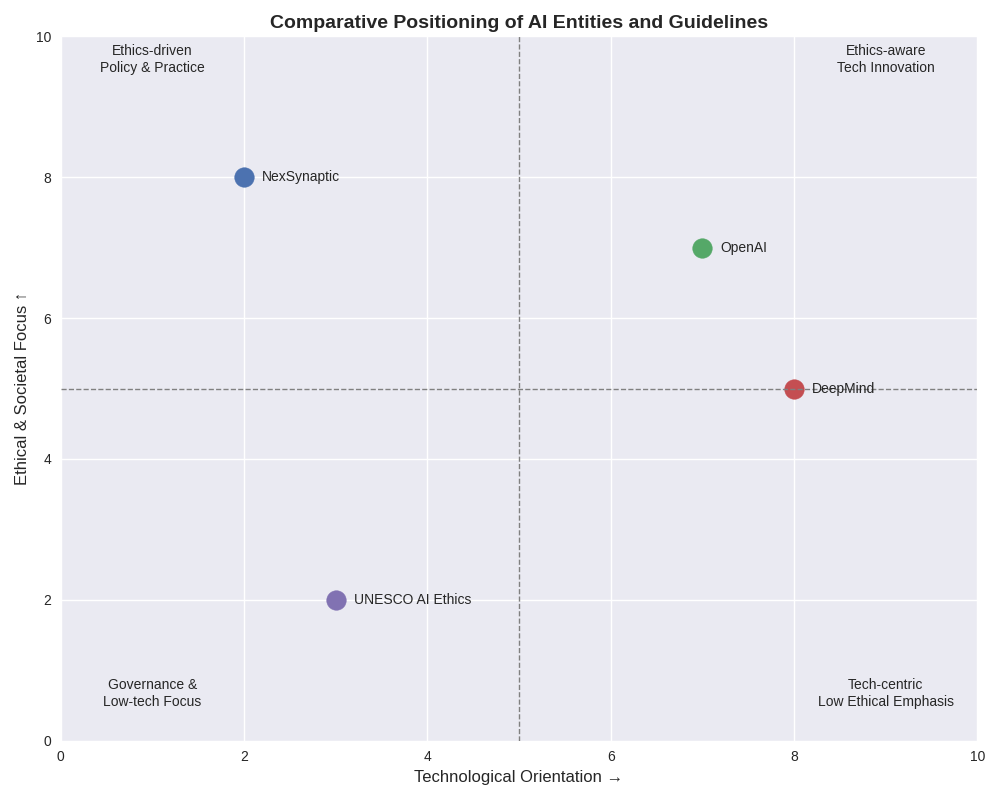
NexSynaptic belongs in the top left quadrant: strong on ethics, moderate on technology compared to commercial giants. Its focus is on neuromorphic computing and spiking neural networks, mimicking how the human brain processes information.
Ethics is central: transparency, human‑in‑the‑loop oversight, and compliance with GDPR and the EU AI Act. NexSynaptic shows that AI can be developed responsibly, prioritizing education and values over profit.
Healthcare: supporting neurotechnology research.
Education: helping learners visualize and understand machine learning processes.
Policy discussions: offering resources for responsible AI advocacy.
OpenAI sits in the top right quadrant: a technological powerhouse with visible ethical awareness. Its generative AI systems — ChatGPT, DALL·E, Codex — are widely used in productivity, creativity, and business.
OpenAI emphasizes safety and responsibility, though critics argue commercialization sometimes overshadows transparency. Still, OpenAI represents a balance: pushing boundaries of innovation while acknowledging risks like bias, misinformation, and misuse.
About Merge Labs BCI read this article.
DeepMind (middle right quadrant) is a leader in deep learning and general AI. Its breakthrough, AlphaFold, revolutionized biology by predicting protein structures.
Ethics exists through internal boards, but technology clearly dominates. DeepMind shows how AI can drive scientific discovery at a global scale, but also highlights the risk of ethics being secondary to technological ambition.
UNESCO AI Ethics Guidelines (bottom left quadrant) provide a global framework: privacy, fairness, inclusivity, human rights. Unlike the others, UNESCO doesn’t build AI — it sets the rules of the game.
Its role is normative: guiding governments, organizations, and companies to align AI development with universal values.
NexSynaptic: ✅ Strong ethical foundation, ❌ limited commercial influence.
OpenAI: ✅ Powerful generative AI, ❌ criticized for partial transparency.
DeepMind: ✅ Scientific breakthroughs, ❌ ethics secondary to technology.
UNESCO: ✅ Global ethical framework, ❌ no direct technological development.
Together, these four initiatives show us that the future of AI depends not only on technological power but also on embedding ethics at every step.
NexSynaptic demonstrates how AI can be developed responsibly with education and transparency at its core.
OpenAI balances innovation with ethical awareness, though commercialization complicates the picture.
DeepMind pushes the boundaries of science and technology, with ethics present but not central.
UNESCO provides the global ethical compass, ensuring that AI aligns with human rights and values.
Responsible AI means innovation and ethics must walk hand in hand. Neuromorphic models, generative AI, and deep learning all hold extraordinary promise, but without responsibility, they risk creating more problems than solutions.
For a deeper exploration of how artificial intelligence is reshaping scientific methodology, ethics, and epistemology, read our analysis in Artificial Intelligence in the Scientific Paradigm.
🔙 Return to the beginning of the journey