
Technology
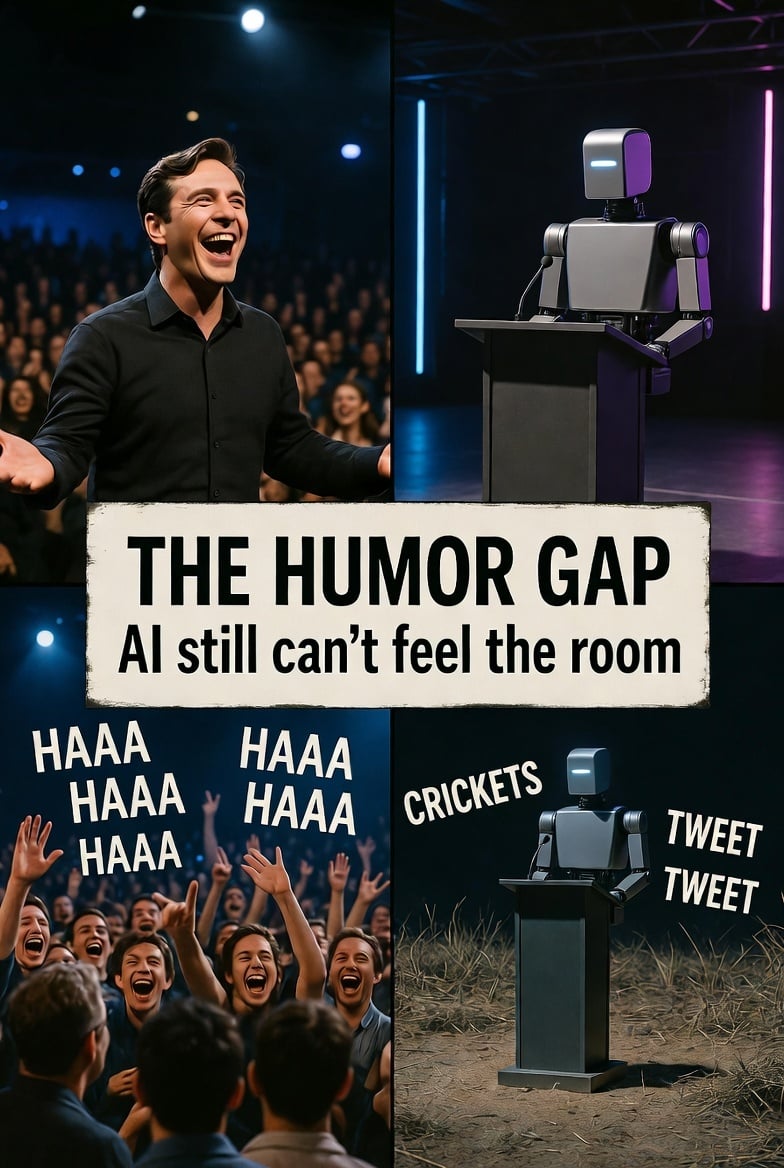

AI writes code, analyzes medical data, drafts legal documents, and generates images that rival professional artists. But there is one domain where AI consistently fails, stumbles, and exposes its deepest limitations:
Humor.
This persistent failure is known as the Humor Gap the distance between AI’s ability to produce humor like text and its inability to understand or experience humor the way humans do. And this gap is a window into:
Understanding the Humor Gap means understanding something fundamental about what makes us human.
Humor is a cognitive and emotional event a collision of:
AI can generate jokes.
But it cannot feel the room. It cannot sense when an audience leans in.
It cannot detect when a joke is too dark, too soon, or too subtle.
It cannot understand embarrassment, tension, or irony. Because Humor is not a formula. It’s not a punchline. It’s not a pattern that can be memorized.
This is the Humor Gap:AI can imitate humor, but it cannot inhabit it.
A joke that works in one culture may fall flat in another. AI models are trained on global datasets, but they lack embeddedness they don’t grow up inside a culture.
Comedy is rhythm. A pause can be funnier than a punchline. AI has no internal sense of comedic timing.
Humor is emotional. AI has no emotions. It cannot cringe, blush, or feel awkwardness all essential comedic ingredients.
Humor is a social signal. It communicates belonging, rebellion, identity, and vulnerability.
AI is not a social being.
Great comedy pushes boundaries.AI is trained to avoid risk. The result:
safe, bland, predictable humor — AI slop.
Different forms of sensory input activate the brain in distinct ways, and even music can strongly influence neural processing, as shown in our analysis of which music activates the brain the most.
As AI models train on massive datasets, they inevitably ingest:
This raises a critical ethical question: Is training on comedians’ material a form of intellectual property theft?
Comedy is creative labor.
A joke is a crafted idea.
A routine is a performance.
A comedic voice is a brand. If AI learns from thousands of comedians and then generates “new” jokes, is that:
Recent example of great new AI joke:
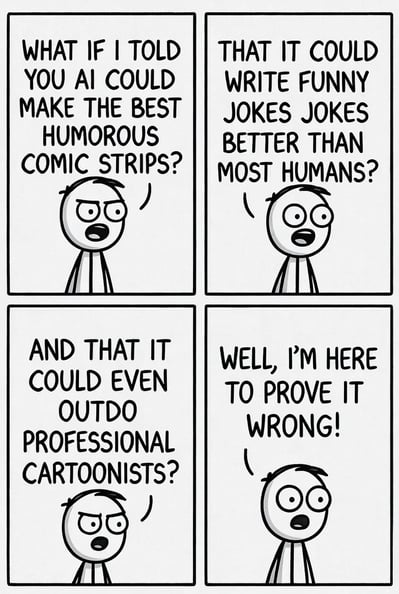
This joke works, but AI still doesn’t understand why it’s funny.
Mass AI content generation is flooding the internet with:
This phenomenon often called AI slop threatens to dilute the value of real comedic craft. Worse, it threatens the career ladder of comedy:
These are the first roles at risk of replacement. If AI replaces the bottom rungs, the entire creative pipeline collapses.
Because humor is so difficult for AI, researchers have begun building specialized benchmarks like HumorBench, which test:
The results are consistent: Even the most advanced AI models fail at humor in ways humans intuitively succeed.
AI can mimic. AI can remix. AI can generate humor‑like text.
But AI cannot understand why something is funny.
AI writes jokes, but it doesn’t feel when they’re hilarious.
This is the heart of the Humor Gap. Humor is emotional.
It requires:
AI has none of these. It can simulate emotion, but it cannot experience it. And without emotional grounding, humor becomes a hollow imitation.
AI becomes culturally aware, emotionally sensitive, and socially intelligent enough to generate authentic humor.
Humor is tied to consciousness, embodiment, mortality, and lived experience.
If AI never develops these, it may never truly “get” humor.
AI becomes a powerful tool for:
…but humans remain the source of authentic comedic insight. They also relate to broader AI trends shaping the future of intelligent systems, which we explore in our analysis of AI success, limitations, and marketing myths.
The Humor Gap is not just about jokes. It reveals deeper truths about AI:
Humor exposes the limits of machine intelligence more clearly than any benchmark. It shows us where the line between human and machine still holds. These findings complement neurotechnology research exploring how machines interface with the human brain, as discussed in our overview of neuromorphic computing.
Humor May Be the Last Human Frontier
AI is advancing it is reshaping work, creativity, communication, and culture. But real humor remains stubbornly human. The Humor Gap is not a bug.
It is a reminder that:
AI may write brilliant jokes, it already does. It may even perform them in the future. But until it can feel the room, comedy will remain a human domain. And that is something worth protecting.
Explore related pillars
👉 Neurotechnology Guide – Neural data, BCI systems, and neuro‑AI.
👉 AI Trends Guide – Key shifts shaping the future of AI.
👉 Ethics Guide – Foundations of responsible AI.
Browse all Brain science articles👉Brain science
For a full overview, visit the main Brain science Guide.
→ https://www.nexsynaptic.com/brain-science
👉 AI Agents Are Coming Fast — Regulation Must Catch Up
🔙 Return to the beginning of the journey
Explore more topics:
Ethics • AI Trends • Neurotechnology • Digital Safety • Brain Science • AI Tools • Technology