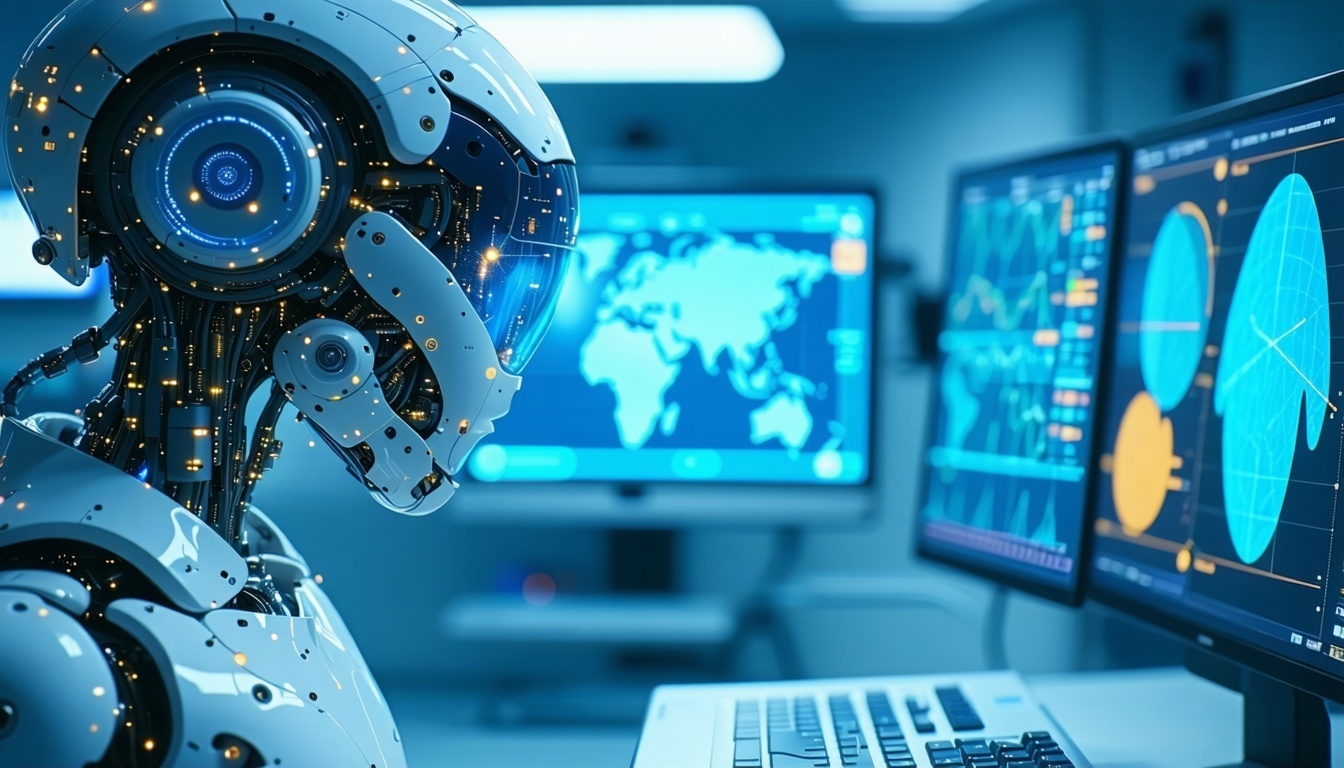
A robot that doesn’t know how to stop.
The human brain is an incredible pattern recognizing machine even when the patterns aren’t real, a sharp contrast to artificial and spiking neural networks, which process information in fundamentally different ways. Evolution taught us that it’s better to “see” a threat that isn’t there than to miss a real one. The brain hates uncertainty. When information is missing, it fills the gaps with assumptions.If you’ve ever been in love and jealous, you know exactly how that works.
The same mechanism drives decision‑making:
pattern recognition saves energy, so the brain reacts faster when something feels familiar.
What about AI?
People often say: “AI gets tired and starts giving weaker answers.”
Not quite. AI doesn’t get tired but it can appear weaker due to:
- context overload
- long conversations
- model limitations in maintaining depth
- overly abstract or repetitive prompts
AI doesn’t collapse from exhaustion but it can collapse in precision.
Robots working 24/7?
Yes, they can work nonstop.
No, they don’t get tired like humans but accuracy can drop. Why?
- sensors heat up or degrade
- software accumulates small errors
- models start processing information more shallowly
- the system lacks the instinct to say “stop, something’s off”
A human slows down when tired.
A robot, when “tired,” doesn’t slow down it makes mistakes over and over. That’s where the real risk lies.
Human and artificial intelligence operate differently, and both have limits.
Human intelligence has limitations rooted in biology: the brain consumes energy, gets tired, and is affected by stress, emotions, and cognitive biases. Yet these very “flaws” enable flexibility, intuition, and the ability to respond to unpredictable situations. Humans can detect nuances, context, and risks that aren’t explicitly visible, and they instinctively stop when something feels wrong.
Artificial intelligence and robots face a different set of limitations. They don’t understand meaning; they predict patterns statistically, which means they lack genuine situational awareness. Their accuracy depends on the quality of data, models, and sensors, and their systems can degrade over time due to heat, mechanical wear, or the accumulation of software errors. AI cannot assess risk, doesn’t know when it’s making mistakes, and cannot stop itself when conditions become unsafe.
Even with emerging concepts like the
digital twin brain, which aim to simulate human‑like cognitive processes, humanoid robots still lack the intuition, improvisation, and situational awareness that humans naturally possess
.
Humanoids vs. Human Labor: The Economics Behind the Shift
Humanoid robots are moving into industry faster than expected. Companies like BMW are already testing them in repetitive, physically demanding, and low‑complexity tasks. As this shift accelerates, one question becomes central: what is the true cost of operating and maintaining humanoid robots in real industrial environments? This is an economic transformation driven by labor shortages, rising wages, and the global push for higher productivity. As industries adopt humanoids at scale, understanding the long‑term evolution of these systems is essential a direction explored in the future of neurorobotics, where robotics and neuroscience converge to create safer, more adaptive machines .
Tesla Optimus- Energy Costs
The Most Predictable Part of the Equation According to available data for Tesla Optimus, energy consumption ranges between 100 and 300 W.This translates to:
- 10 hours of work → 1.0–3 kWh
- energy price: 0.15–0.30 €/kWh
- daily cost: 0.15–0.90 €
- annual cost: 50–330 €
Energy cost is almost irrelevant in the long‑term financial model.Even continuous operation remains cheaper than most basic operational expenses in manufacturing or logistics. This is why companies focus on operational efficiency, uptime, and long‑term reliability ,the real drivers of cost.
Maintenance Costs: The Critical Unknown
A humanoid robot includes:
- 28 actuators
- multiple cameras
- sensors
- computing modules
- complex electronics
Any of these components can fail.If failures are frequent, maintenance cost becomes the dominant expense. What we still don’t know:
- service intervals
- replacement part pricing
- expected lifespan of actuators and sensors
- long‑term durability under industrial workloads
- failure patterns (gradual wear vs. sudden breakdowns)
This single category maintenance and reliability will determine whether humanoids become cheaper or more expensive than human labor.
Cyber‑Security, Edge‑AI Limitations and Safety Standards
Humanoid robots introduce a new class of security challenges because they combine physical autonomy, network connectivity, and edge‑AI processing, which makes them vulnerable to
sensor manipulation,
actuator hijacking,
and attacks on communication protocols.
Research has demonstrated real attacks such as sensor spoofing on embodied AI systems and online data/model poisoning on edge‑AI and OTA‑based learning systems. If standardized, such attack classes would need to be explicitly addressed in safety frameworks like ISO 10218 and ISO/TS 15066. ( Online data poisoning attack against edge AI paradigm for IoT-enabled smart city ).
Limited computational resources on the edge make it difficult to implement strong encryption and continuous model‑integrity checks, while OTA updates carry the risk of model poisoning. This is why standards such as ISO 10218 and ISO/TS 15066 are applied to define limits on force, speed, and emergency‑stop procedures, but humanoids require extensions of these frameworks because they combine mobility, manipulation, and autonomous decision‑making.
If Maintenance Is Cheap: Rapid Industrial Adoption
If humanoids prove reliable and affordable to maintain, industries will adopt them quickly.This aligns with global trends:
- rising labor costs
- workforce shortages
- demand for higher productivity
- pressure to reduce operational downtime
- need for scalable and predictable labor capacity
In this scenario:
- humans shift to supervision and oversight
- repetitive labor becomes automated
- productivity increases
- operational costs decrease
- companies gain more flexibility in planning and scaling
Humanoids become a strategic workforce multiplier.
If Maintenance Is Expensive: Human Labor Remains Dominan
If maintenance costs rise due to frequent breakdowns or expensive parts, companies will continue relying on human workers especially in environments where flexibility, adaptability, and problem‑solving matter more than mechanical precision. In this scenario:
- humanoids remain niche tools
- industrial transformation slows
- human labor retains economic advantage
- companies avoid high‑risk investments
The market will naturally regulate the pace of adoption.
Today’s industrial landscape offers unprecedented flexibility:
- human labor
- traditional automation
- humanoid robots
- hybrid workforce models
The Human Advantage: Skills Machines Still Can’t Match
Despite rapid progress, humans still outperform machines in:
- intuition– humans make decisions based on experience, emotions, and judgments that are not explicitly calculated
- improvisation– humans can adapt to unexpected situations without predefined rules
- contextual judgment– understanding nuances, social signals, and implicit meanings
- situational awareness– recognizing risks, environmental changes
- the ability to stop when something feels wrong, humans naturally pause when they sense danger, fatigue, or uncertainty
We know that:
- humanoids can work 24/7 without fatigue
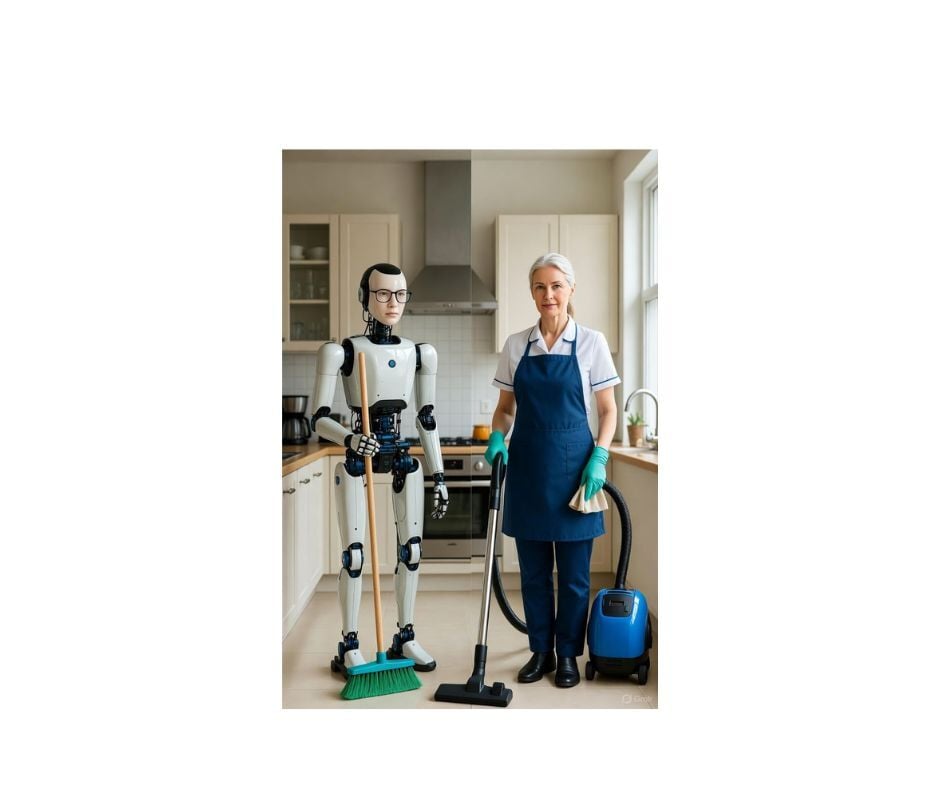
- they can replace humans in repetitive, dangerous, or physically demanding tasks
- they can lift more or move faster
But this is only true as long as the system operates within the boundaries it was designed for. Oversight and safety protocols remain essential .
This is why the development of advanced systems increasingly focuses on neurorobotics, a field that explores how machines can better understand context while still requiring human oversight .
The Market Will Decide and Humans Will Adapt
No matter how the economics evolve, one thing is certain: humans will adapt.
If humanoids become affordable and reliable, people will shift into roles requiring oversight, creativity, decision‑making, and problem‑solving. If humanoids remain costly to maintain, human labor will continue to dominate.
In both scenarios, work evolves and it doesn’t disappear.
Explore how AI thinks, what it understands, and where its real limits are, take a look at my conversation with artificial intelligence about the future of technology and humanity.
Explore related pillars
Read more about Technology 👇