
AI trends

Artificial intelligence has shifted from experimental technology to essential digital infrastructure, raising concerns about a growing AI divide and unequal access to advanced technologies. As AI becomes embedded in education, healthcare, finance, and public administration, a critical question emerges: Who benefits from AI and who is being left behind?
A major study published in PNAS Nexus warns that AI’s benefits will not be distributed evenly and may deepen existing socioeconomic inequalities.¹
This makes AI inequality one of the most important global challenges of the decade.
AI is transforming key sectors, but access to these benefits is uneven. Differences in infrastructure, computing power, internet access, and digital skills determine who can use AI and who cannot a pattern increasingly described as the global AI access gap.
AI affects cognitive occupations the most, while physical jobs remain less automated. Productivity gains are concentrated among those with access to advanced tools, widening gaps in income and opportunity. This creates a new form of AI‑driven labor inequality.
Students with access to digital tools and AI tutors achieve better results, while those without such access fall further behind.¹ This creates a structural educational divide that compounds over time a trend often referred to as the AI education gap.
AI improves diagnostics and efficiency, but only in systems that have the infrastructure to deploy it.¹ This means that the health benefits of AI are not evenly distributed across countries or socioeconomic groups, reinforcing the digital health divide.
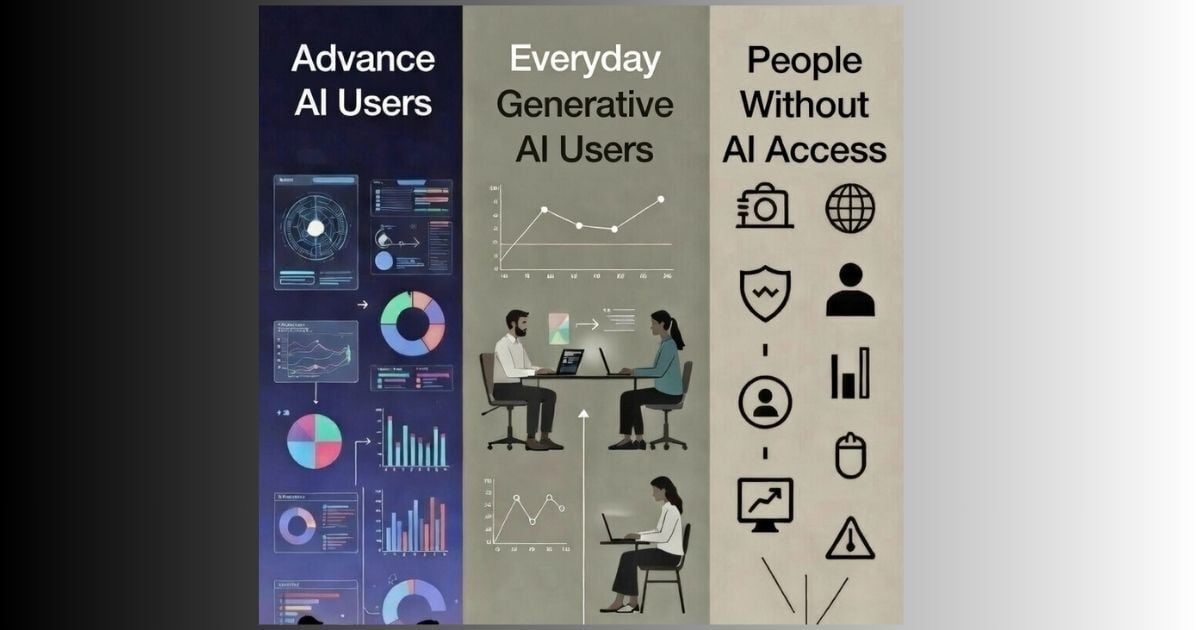
Global society is already splitting into three layers based on access to artificial intelligence a phenomenon increasingly described as AI stratification.
1. The AI Elite
This group includes major tech companies, research labs, and institutions with access to the most advanced models and computing clusters.
Advanced AI is used in biomedicine, science, finance, and industry to optimize processes and develop new solutions.
Models like AlphaFold 3 enable protein structure prediction faster than ever before.² These organizations shape the frontier of AI innovation.
2. The AI‑Enabled Middle Class
Professionals in education, engineering, design, management, and creative industries use generative tools such as ChatGPT, Claude, Gemini Ultra, or Copilot.
GitHub confirms that Copilot increases developer productivity, although the exact percentage varies by task and context.³ This group represents the mainstream adoption of generative AI.
3. Populations Without AI Access
A large part of the world’s population still lacks access to stable internet, computers, or digital skills.
ITU and UNESCO highlight that the digital divide is especially pronounced in lower‑income countries, where access to advanced technologies is limited by infrastructure and cost.⁴ ⁵ This is the global digital exclusion zone.
The PNAS Nexus study identifies several mechanisms through which AI can widen or reduce inequality:¹
- productivity gains concentrated among those with access
- educational gaps widening without equal digital access
- healthcare improvements limited to well‑resourced systems
- concentration of power among institutions controlling advanced models
These findings position AI access as a new axis of global inequality often described as algorithmic inequality or AI driven socioeconomic stratification.
Differences in AI access translate into differences in productivity, income, employment opportunities, and quality of life.
Without intervention, AI could amplify existing divides between individuals, regions, and countries.
Examples from everyday life:
A professional with access to AI can complete work several times faster.
A student with an AI tutor can learn more efficiently and achieve better results.
Companies with advanced AI can innovate faster than their competitors.
This dynamic accelerates the AI productivity gap, which in turn shapes long‑term economic outcomes.
The EU AI Act (Regulation (EU) 2024/1689) is the world’s first comprehensive AI law, entering full implementation in 2026–2027.⁶
It is widely seen as a cornerstone of AI governance and a model for global regulation.
bans on social scoring
bans on manipulative AI systems
strict rules for high‑risk systems (employment, education, healthcare)
mandatory bias testing
transparency requirements
oversight for general‑purpose AI
support for open models and digital literacy
This framework aims to ensure that AI development remains safe, transparent, and equitable a foundation for responsible AI adoption.
A more inclusive AI ecosystem requires:
investment in digital infrastructure
development of open, accessible AI models
AI education in schools and universities
support for SMEs adopting AI
international cooperation to reduce the global digital divide
These steps can help ensure that AI becomes a tool for shared prosperity rather than a driver of inequality the core principle behind equitable AI access.
In my work with AI tools and digital projects, I see that the biggest divide is human, not technological.
Organizations and individuals who understand how to integrate AI into their workflows advance extremely quickly, while others adapt slowly and with difficulty. The difference in outcomes is dramatic: productivity, learning speed, and decision‑making quality begin to diverge almost immediately.
This practical gap reflects the broader societal divide described in the research and highlights the urgency of making AI skills accessible to everyone.
Artificial intelligence can be a tool for equality or a source of new divisions.
The PNAS Nexus study highlights the risks, while the EU AI Act offers a path toward fairer AI governance.
The future depends on whether societies choose to make AI accessible to all.
While global disparities in AI adoption continue to widen, the industry’s accelerating pace introduces an additional layer of systemic risk explored in The AI Industry and the “Lion Cub” That’s Growing Too Fast.
Endnotes
¹ Capraro, V., Lentsch, A., Acemoglu, D., et al. (2024). The impact of generative artificial intelligence on socioeconomic inequalities and policy making. PNAS Nexus, 3(6), pgae191. https://doi.org/10.1093/pnasnexus/pgae191
² DeepMind. AlphaFold 3 (2024).
³ GitHub. GitHub Copilot Productivity Research (2024).
⁴ ITU. Digital Development and AI Capacity Reports (2025).
⁵ UNESCO. Recommendation on the Ethics of Artificial Intelligence (2021, updated 2025).
⁶ Regulation (EU) 2024/1689 — EU Artificial Intelligence Act.
Read more in future👇
AI as a Strategic ResourceThe AI Industry and the “Lion Cub”
AI Transparency: This article was written by the author. AI tools were used to support editing and grammar refinement. This article contains AI‑generated images. The final version was reviewed by a human.
Explore related pillars
👉Digital Safety Guide - A framework for privacy and safe digital ecosystems.
👉Neurotechnology Guide - A framework for neural data, BCI technologies, and neuromorphic computing.
🔙 Return to the beginning of the journey
Explore more topics:
Ethics • AI Trends • Neurotechnology • Digital Safety • Brain Science • AI Tools • Technology