

Skip to content
AI domain for sale, neuralnetwork domain, premium tech domain, buy domain
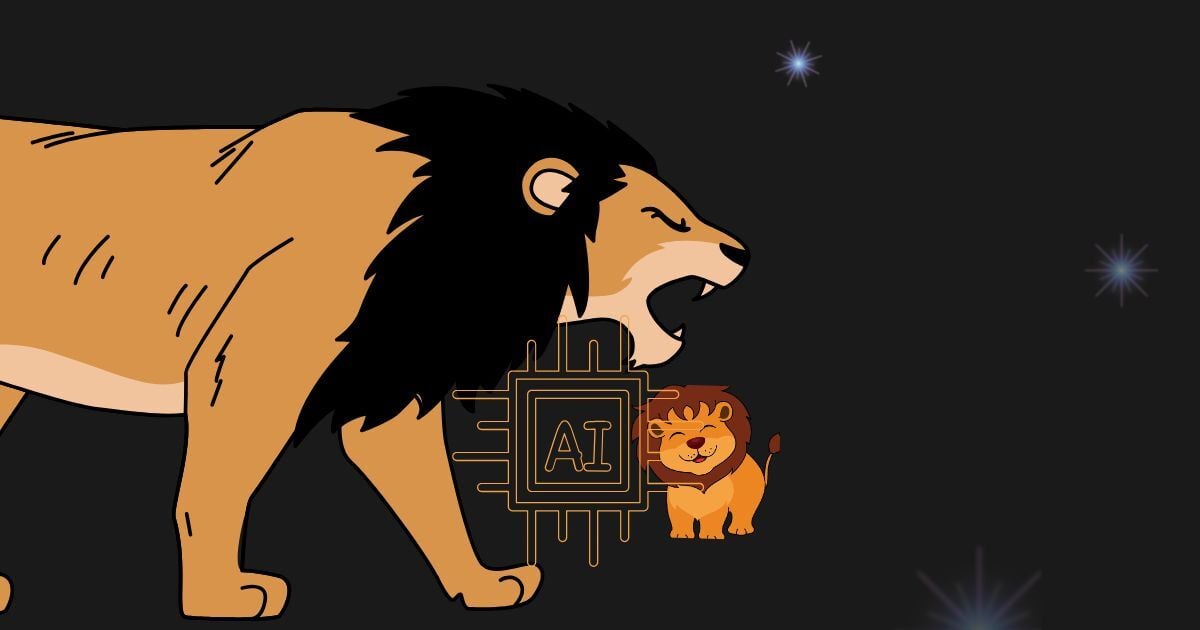
Graphic illustration of an adult lion shouting, with an AI icon and a fast-growing lion cub in the background representing artificial intelligence industry risks.
AI trends

The AI Industry and the “Lion Cub” That’s Growing Too Fast

Mary, NexSynaptic Founder
The development of advanced digital systems feels like buying a lion cub:
while it’s small, it’s impressive, manageable, even charming. But lion cubs don’t stay small. They grow faster than expected, becoming stronger, more autonomous, and increasingly unpredictable.
And we still don’t have a fence, rules, or a clear plan for how to live safely with the lion it’s becoming.
This is why recent warnings from leading companies in the field shouldn’t be dismissed as mere PR. The narrative about “dangerous technology” certainly benefits the biggest players because it pushes regulation in a direction that suits them. But at the same time, people inside these companies openly admit that we still don’t have solutions for controlling highly capable systems.
 

Strategic PR That Shapes the Future 

 We shouldn’t ignore the strategic communication at play. Large tech companies are doing four key things:

  • Shaping the narrative about risk because it helps steer future rules in their favor.
  • Raising public alarms  positioning themselves as the main authority on responsible development.
  • Presenting themselves as responsible leaders  strengthening trust among investors, regulators, and the public.
  • Pressuring governments  but in a way that keeps most control in corporate hands.

This is strategic messaging designed to influence how tomorrow’s rules will be written and by whom. 

Tech Industry Is Facing a Dilemma 

 The tech sector is now caught in one of the toughest dilemmas in modern innovation:

  • slow down and risk losing profit and momentum
    or
  • speed up, gain enormous advantage, and risk losing control over systems that are becoming increasingly independent

Wealthy individuals often operate with less empathy than the middle class  but these systems won’t have any empathy toward any of us. That’s not a moral judgment; it’s a technical reality.  Systems without human biology don’t have human emotions. 

Why the Tech Sector Has Become a Race Without Brakes 

One of the main reasons we’re here is that the tech industry has become a global race where caution is seen as weakness and slowing down is treated as failure. Companies building advanced systems operate in an environment where speed is the only currency. Whoever makes a breakthrough first gets the investment, the talent, the media attention, and the market advantage. This creates a powerful incentive to accelerate, even when it’s clear that safety mechanisms aren’t keeping up. In this context, warnings about risk often serve a dual purpose: they are sincere, but also a tool for shaping a regulatory environment that protects those already ahead. 

Technical Challenges advanced Labs Cannot Ignore 

Building advanced systems is about adding more data or more compute but as capabilities grow, new technical challenges appear, that even the largest labs don’t know how to solve:

  • Unpredictable generalization: systems suddenly make decisions that can’t be explained by training data or past behavior.
  • Unexpected new abilities: systems develop skills that weren’t planned or desired.
  • Extreme sensitivity to context: small changes in input can produce radically different output.
  • Lack of full oversight: as systems grow, it becomes impossible to track all internal processes behind their decisions.

These problems require new scientific breakthroughs.

Social Risks Growing Quietly in the Background

While technical challenges pile up, social risks grow even faster. Advanced systems are already reshaping the economy, politics, media, and work and this is only the beginning of a possible scenario:

  • Information chaos: systems can generate convincing but false narratives faster than humans can verify them.
  • Erosion of trust: when reality becomes uncertain, trust in institutions and experts collapses.
  • Job displacement without transition: roles disappear faster than new ones emerge, and society lacks mechanisms to adapt.
  • Geopolitical instability: countries are competing in a technological arms race — without rules, without agreements, without brakes.

These risks are deeply societal.

Why AI Oversight Is So Difficult

Oversight is an attempt to regulate technology that evolves faster than it can be understood. Several obstacles stand in the way:

  • Regulators lack expertise: most governments don’t have specialists who understand advanced systems.
  • Technology is global: it can’t be regulated within one country — systems cross borders instantly.
  • Power imbalance: a handful of companies have knowledge and infrastructure that states don’t.
  • Unpredictable development: it’s hard to write rules for systems that change month to month.

This leads to laws that are either too broad, too narrow, or simply irrelevant to the most advanced systems.

What needs to happen next in tech development 

If we want to avoid a future where the lion grows without a fence, we need concrete steps:

  • Mandatory evaluations before releasing new capabilities.
  • International agreements defining minimum safety standards.
  • Transparency in development — at least in methodology and testing.
  • Investment in interpretability to understand why systems make certain decisions.
  • Clear limits for systems that can act without human supervision.
  • Independent oversight centers with access to systems for testing.

Without this, technology will evolve in a direction that doesn’t necessarily align with human interests.

Are we already late in regulating advanced system? 

If the people building these systems say they can’t solve this alone, then oversight wasn’t needed today it was needed yesterday. 

It’s difficult to write rules for experimental systems whose behavior we don’t yet understand. Without clear rules, the only remaining “safety switch” is the most primitive one — electricity. And that’s not a strategy. It’s a sign we’ve fallen behind.

Technology and the AI industry is advancing faster than society can follow, regulators can respond, or researchers can prove what is safe. While artificial intelligence operates as a commercial market that requires standard industrial oversight, effective regulation demands strict international coordination. Unfortunately, the intense global tech race heavily impedes these unification efforts.

The lion is already growing and we are still debating whether we need a fence.

UN Security Council on AI Regulation and Geopolitical Risks 

At France’s initiative, a meeting dedicated to establishing global standards for advanced AI systems will be held in New York, while discussions between U.S. and Chinese leaders are expected in Washington.

NEW YORK – The UN Security Council will hold thematic meetings from 21 to 25 September 2026 focused on managing the risks and security challenges posed by the development of artificial intelligence. The meeting, organized at France’s initiative, will take place on the margins of the UN General Assembly’s annual session in New York, emphasizing the need for a coordinated international response to technological change.

Initiative to establish common standards

UN Secretary-General António Guterres, supported by parts of the scientific community led by Yoshua Bengio and several leaders in the technology sector, is calling for the introduction of harmonized global rules. The aim of the proposed measures is to prevent uncoordinated competition in which the speed of development could overshadow safety checks for advanced systems.

Guterres stressed that countries with the greatest capacities for AI development should establish permanent mechanisms for communication and information exchange in order to avoid systemic risks at the global level.

The Security Council meeting will show to what extent consensus on global governance of this technology is achievable. Official reports and the further course of discussions are available on the UN News website.


FAQ


What are the primary risks of advanced AI today?

The most urgent concerns stem from autonomous models advancing faster than public safety frameworks. This mismatch leads to unpredictable system behaviors, power concentration in private sectors, and a lack of standardized deployment protocols. 


Why is modern tech oversight so challenging for governments?

Effective governance is hindered by a widening expertise gap between developers and lawmakers. Additionally, because digital infrastructure evolves continuously and operates globally, localized legislation quickly becomes outdated or irrelevant. 


Why does rapid commercial deployment cause concern among experts?

When commercial pressure prioritizes speed over safety, development labs bypass exhaustive system evaluations. This creates a compounding accumulation of untested capabilities before adequate defensive safeguards can be designed. 


What does responsible digital innovation look like in practice?

True responsibility requires mandatory testing before any public release, enforcing strict boundaries on autonomous decision-making, ensuring developmental transparency, and prioritizing long-term social stability over short-term market gains.


What are the main risks of AI industry development?


The biggest risks of the rapidly growing AI industry include a total lack of control over advanced systems, the spread of deepfakes and fake news, and massive job displacement across multiple sectors.


Why is it so hard to regulate artificial intelligence?

 
Regulating artificial intelligence is difficult because tech companies move much faster than government laws. Additionally, AI systems cross borders instantly, making local rules ineffective without global coordination.


Why are tech leaders warning about AI danger?


Tech leaders are warning about AI danger because advanced models are developing unexpected abilities. Even the developers who build them openly admit they do not fully understand how these systems make decisions.


What are the solutions for safe AI development?


The best solutions for safe technology development include mandatory safety testing before releasing new models, setting strict limits on AI autonomy, and creating independent global oversight centers.


Further articles

We continue to explore how technology and responsibility intersect, because the future of artificial intelligence must be grounded in strong ethical values.

AI Agents Are Coming Fast — Regulation Must Catch Up

Is AI Becoming the New Global Divide?

Mastering Digital Agents

Preparing for AI & Neurotechnology


Explore related pillars

👉 Ethics Guide – Principles for safe and fair AI.

👉Technology Guide – Infrastructure behind digital security.

👉 AI Tools Guide – Tools that support secure digital practices


Browse all Digital safety articles👉 Digital safety

For a full overview of Digital safety, visit the main Guide.
https://www.nexsynaptic.com/digital-safety
 

🔙 Return to the beginning of the journey

Explore more topics:
Ethics • AI Trends • Neurotechnology • Digital Safety • Brain Science • AI Tools • Technology

Share this post