X account suspended
I spent few months building a solid X profile: steady growth, engagement, everything running smoothly.
Then one day, I decided it was time for a little “spring cleaning.”
Too many accounts followed, too much noise.
So I spent a few minutes unfollowing people I no longer needed in my feed.
And then — BOOM :
“Your account is suspended. If you think we got this wrong, you can submit an appeal.”
I appealed, explained everything.
No malicious intent, no automation, no spam , just cleaning up my feed.
The response?
“After careful review, you broke the X Rules.
You are permanently in read‑only mode.
You cannot submit an appeal.”
Great. I unfollow people on my own account and suddenly I’m a threat to society.
I appealed again, because why not.
And then I received this masterpiece:
“Our automated systems have determined there was no violation and have restored your account to full functionality.”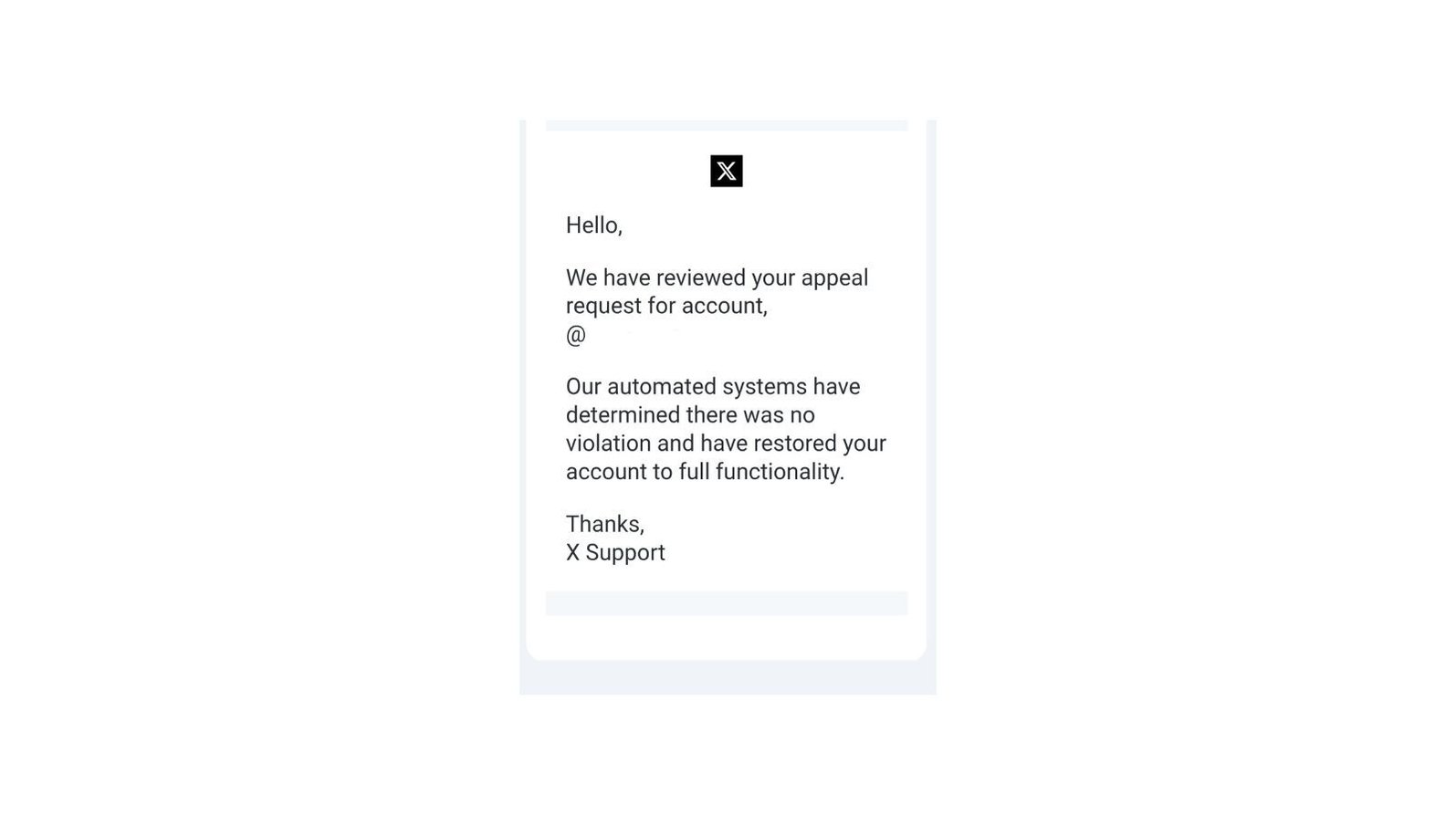
Full functionality? Amazing. Except… nothing worked.
I appealed again.Same message. Word for word.
We were now in a copy‑paste relationship.
I even tried deleting the account (a simple GDPR “right to erasure” request).
The reply?
“Our automated systems have determined there was no violation and your account is unlocked.”
I tried posting.
Still nothing.
Welcome to:
🎪 The Algorithmic Circus
Suspended → Unsuspended → Unlocked → Still broken
Appeal → Copy‑paste → Appeal → Copy‑paste → Existential crisis
What Is a State Mismatch Bug
This is a classic state mismatch bug a type of algorithmic where the system can’t decide whether your account is suspended or active.
One algorithm: suspended
Another algorithm: unblocked
The system: stuck in read‑only mode.
The result: I can log in, but nothing works.
It’s one of the clearest examples of automated moderation contradicting itself and leaving the user trapped between two disagreeing systems.
If you want to understand how issues like this fit into the broader framework of AI regulation, take a look at my in‑depth guide to the EU AI Act and autonomous AI agents, where I explain how the law defines responsibility, risks, and oversight for automated systems.
EU AI Act vs DSA vs GDPR: What Really Applies Here
EU AI Act — Relevant, but Not the Main Law
This situation is a textbook example of what the EU AI Act tries to address:
AI systems making contradictory decisions without transparency or human oversight.
But to be precise:
X moderation algorithms fall under limited‑risk AI, not high‑risk.
They must:
- be transparent
- allow human oversight
- allow appeals
- avoid unexplained decisions
…but they are not regulated as strictly as AI in healthcare, policing, or employment.
DSA and GDPR — The Real Legal Framework for EU Users
For EU users, the key protections come from:
- Art. 20(4): complaints must be handled carefully, non‑arbitrarily
- Art. 20(5): platforms must provide a reasoned decision
- Art. 20(6): decisions must involve qualified human review, not only automation
Your rights include:
- the right not to be subject to decisions based solely on automated processing
- the right to human intervention
- the right to challenge the decision
- the right to understand the logic behind the algorithm
The Core Issue: No Published Rule Was Broken
X does not publicly state:
“You cannot unfollow more than X accounts per hour.”
This means:
- I couldn’t know I was breaking anything
- the algorithm arbitrarily decided unfollowing = spam
- no explanation was provided
- no human oversight corrected the mistake
Even X’s own documentation makes the inconsistency obvious:
“Following (daily): The technical follow limit is 400 per day. Please note that this is a technical account limit only, and there are additional rules prohibiting aggressive following behavior.”
The problem is simple:
X mentions “additional rules,” but these rules exist only as broad behavioral categories not as clear, measurable guidelines a user can actually follow.
It’s like being told:
“Don’t drive too fast.”
But no one tells you how fast is too fast.
When rules are vague, enforcement becomes arbitrary.
When enforcement is arbitrary, users lose predictability.
And when predictability disappears, trust collapses.
This is exactly the kind of opaque automated moderation that the DSA and GDPR are designed to address.
The EU AI Act wouldn’t prevent the initial error but it would prevent the situation from remaining unresolved and unexplained.
What You Can Do as a User
If something similar happens to you, you have rights.
1. Invoke the DSA (Art. 20)
Request:
- a reasoned decision
- the specific rule you allegedly violated
- human review of your case
2. Invoke GDPR (Art. 22)
Request:
- human intervention
- explanation of the automated decision
- the right to challenge it
3. Request Access to Logs
You have the right to know:
- what was flagged as “suspicious”
- which system made the decision
- why it was triggered
4. If ignored — escalate to your national regulator
A platform cannot be “confidently wrong” and leave you stuck in a state mismatch bug.
If You’re Reading This and Have a Similar Problem Here’s your quick action checklist:
- Don’t give up.
- Cite DSA Article 20.
- Cite GDPR Article 22.
- Request human review.
- Request an explanation.
- Request access to logs.
- If ignored — report the platform to your regulator.
You have the right to a correction and to a human decision.
Hope this was helpful.
I’ll update you as soon as the algorithms stop arguing with themselves and let my account exist again.
Explore related pillars
👉 Ethics Guide – Principles for safe and fair AI.
👉Technology Guide – Infrastructure behind digital security.
👉 AI Tools Guide – Tools that support secure digital practices
Read more about Digital Safety & AI Risks👇
How to Recognize AI Hallucinations
AI and Child Safety
How to Protect Children from Predatory AI Systems
Algorithmic Mobbing
The Ethics of AI Surveillance
🔙 Return to the beginning of the journey
Explore more topics:
Ethics • AI Trends • Neurotechnology • Digital Safety • Brain Science • AI Tools • Technology