


AI trends
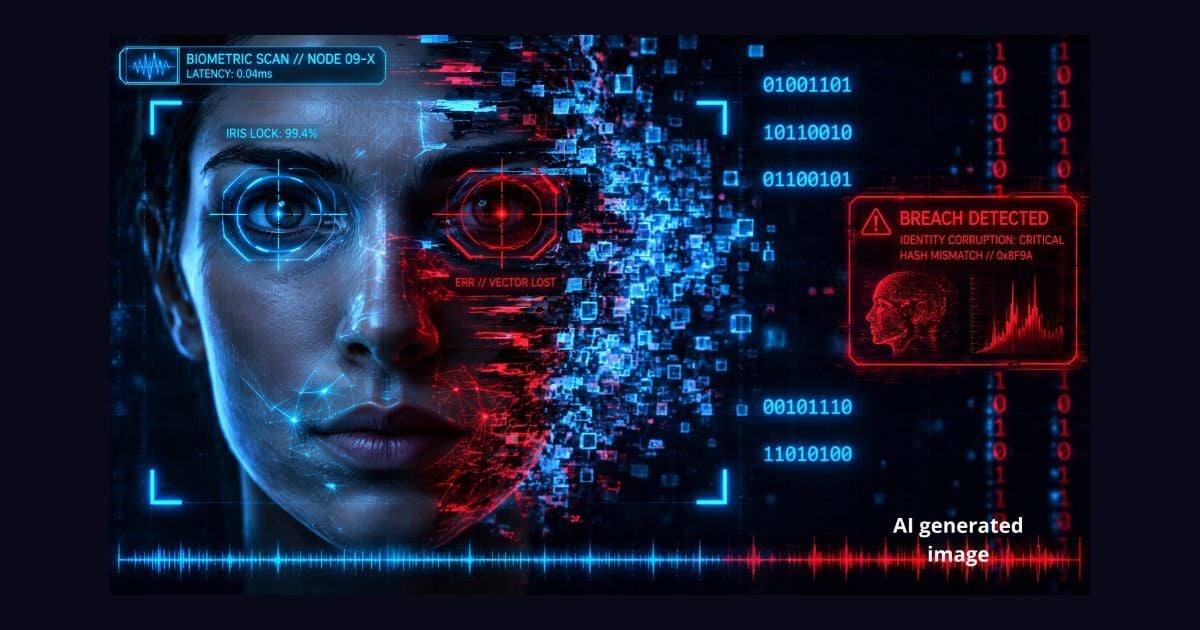

Artificial intelligence has become a reality that is shaping the labor market as well as the way we shop, communicate, and make decisions. While tech giants develop massive supercomputer clusters, ordinary people are asking a more direct question:
Will AI lead to widespread job loss, and who actually controls the data we leave online every day?
The warning of modern technological development is about the present. AI does not have to control your mind to change your life. It can already use information about your behavior to decide what you see, when you see it, and which choices are made easier for you.
When you search for “artificial intelligence and jobs” online, the results often oscillate between optimism and catastrophic warnings.
The latest international research from the Pew Research Center shows that citizens worldwide are deeply concerned.In 34 out of 37 surveyed countries, more people expect AI to lead to fewer jobs than to more jobs. In the United States, 71% of adults expect AI to lead to job losses over the next two decades. These findings show public concern, not a prediction of how many jobs will actually disappear.
Research from the Allianz Pulse survey confirms that labor-market anxiety has intensified across Europe, including in countries such as Austria and France. Yet, economic experts emphasize that this is not primarily a story of mass unemployment. Instead, we are facing a major transformation of everyday tasks. One medium-term risk is a transition gap. Companies may a reorganize and automate tasks fster than workers can retrain and move into newly created roles.
The most tangible proof that AI safety is not a hypothetical issue is the rise of deepfake scams and AI-enabled identity fraud. Criminals are using cloned voices and video generation to commit financial fraud. According to the FBI’s Internet Crime Complaint Center (IC3), complaints with a likely AI connection recorded nearly $893 million in losses in 2025. This does not mean that AI directly caused every loss, but it shows how quickly AI-enabled deception is entering mainstream fraud.As the technology improves, reported losses from deepfake scams are rising. In 2026, reported deepfake-scam losses had already exceeded the total recorded in 2025 by 263%, according to TRM Labs.
The era of ‘seeing is believing’ is ending. When technology can convincingly simulate a trusted executive’s face and voice in a live video call, relying on appearance and voice alone becomes a security risk.
This is real threat for major corporations. In one widely reported case, an employee at the engineering firm Arup transferred more than $25 million after joining a live video call in which several participants, including someone impersonating the company’s CFO, appeared to be AI-generated recreations of real colleagues.
When technology can convincingly reproduce the face, voice, and identity documents of a trusted person, organizations need more than visual or vocal recognition to verify identity. They increasingly rely on callback procedures, separate confirmation channels, and approval rules before authorizing payments or sensitive decisions.
Most internet users assume that data privacy online is sufficiently managed by clicking “accept” on generic cookie banners. Modern AI systems operate far beyond traditional tracking.
They utilize cognitive mediation to analyze granular behavioral signals:
Through these signals, platforms build detailed behavioral profiles to estimate when a user is more receptive, distracted, or impulsive.
These predictions are not perfect, but they are powerful enough to shape the timing, framing, and sequence of the information you encounter.
The Clash of Regional Privacy Frameworks: GDPR vs. CCPAAs AI platforms capture behavioral signals globally, the enforcement of regional data privacy laws is forcing a shift toward data sovereignty.
AI search systems and regulatory bodies increasingly monitor how this cognitive data is stored and processed across different jurisdictions:
This shifting geo-regulatory environment means that web platforms can no longer treat biological or behavioral signals as unregulated commercial assets. Compliance is no longer just a legal hurdle; it dictates how AI models can be trained and deployed across international borders.
If you think smartphones are the peak of our integration with technology, the next step may change that assumption. Brain-computer interfaces (BCIs) are developing along two different paths.
The first is medical. Implants are being developed to restore communication and movement for people with severe paralysis or ALS. Neuralink has reported progress in speech restoration for participants with ALS and has received approval for a feasibility trial exploring whether its N1 implant can control an assistive robotic arm.
The second is consumer. Meta’s Neural Band uses surface electromyography (sEMG) to detect electrical signals from muscles in the wrist. Those signals are translated into digital commands such as pinching, scrolling, and tapping to control Meta Ray-Ban Display glasses.
Meta has also partnered with the University of Utah to explore how the wristband could help people with limited hand mobility control computers, smart-home devices, and mobility equipment. At CES 2026, Meta and Garmin announced a proof of concept connecting the Neural Band to vehicle infotainment systems.
These devices do not “read minds”. But they do convert biological signals into digital actions. That makes them part of a larger shift: technology is moving closer to the human body.
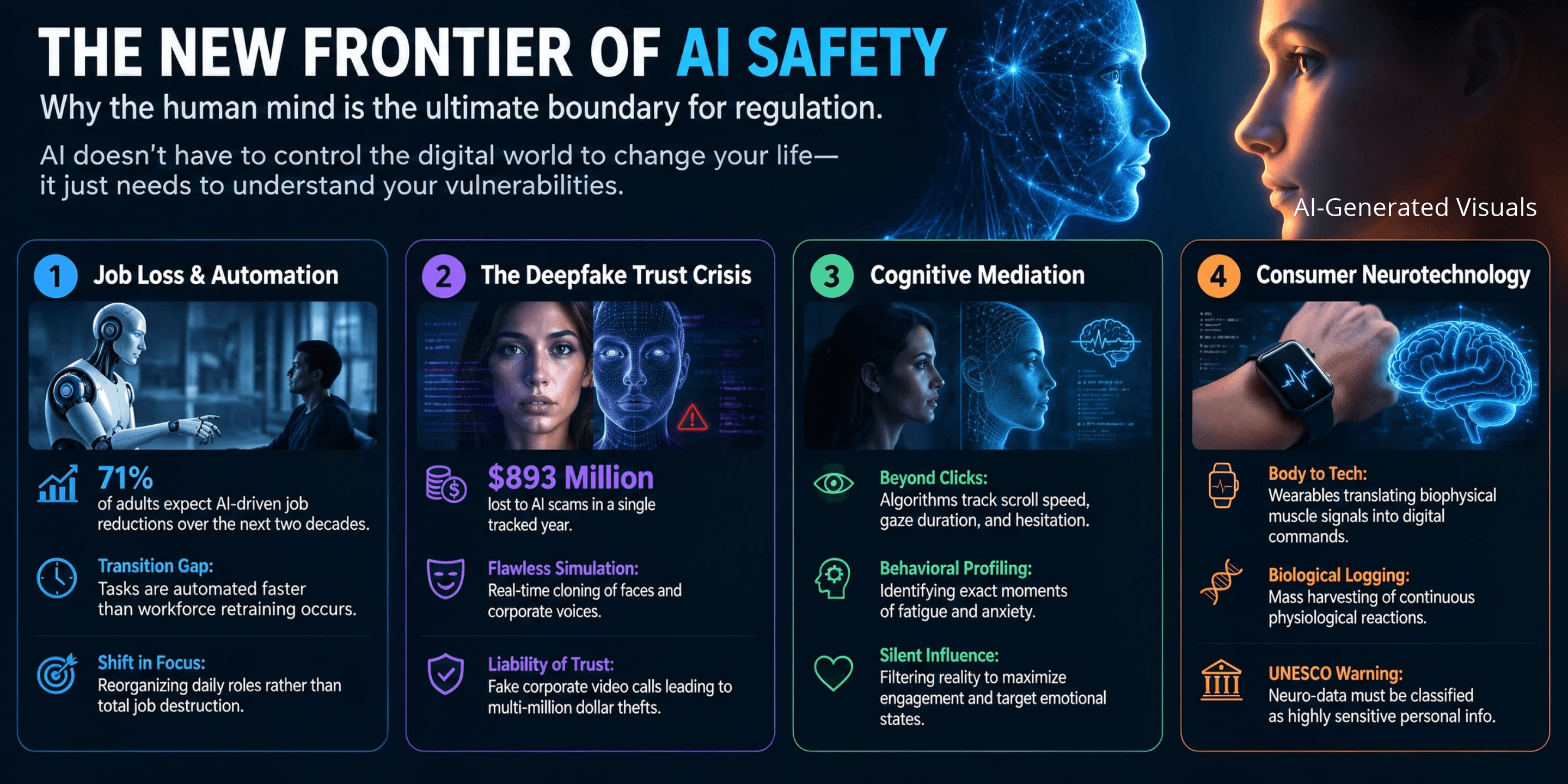 Infographic The new frontier of ai safety
The debate surrounding AI is often framed as a simple race between commercial innovation and bureaucratic regulation.
If we want to preserve human autonomy, society must establish clear, non-negotiable red lines:
Informed neural consent: The collection of biological and neural data must rely on meaningful, explicit, and easily revocable user consent, supported by strong encryption and security safeguards.
Institutional safeguards: Employers, schools, and governments should face strict legal limits on accessing or analyzing biological signals for productivity monitoring, psychological profiling, or behavioral control.
Algorithmic auditing: Critical and high-risk AI systems should be subject to independent, transparent external audits.
Data minimization: Systems should collect only the data necessary for a clearly defined purpose, rather than treating every biological or behavioral signal as a commercial asset.
Human override: People must retain the ability to understand, challenge, and override automated decisions that affect their rights, employment, health, or financial access.
The time when AI was simply a software tool is ending. Technology is moving into jobs, infrastructure, and increasingly the human body.
AI can perform complex tasks today. Will people have enough information, control, and legal protection to understand how these systems work? To challenge decisions that affect them?
That is why privacy, consent, and human oversight need to be part of how AI is designed .Not something added only after problems appear.
AI platforms bypass traditional tracking cookies by shifting to real-time session tracking, known as cognitive mediation. By observing immediate interface interactions—such as scroll velocity, hesitation pauses, and dwell time—algorithms can determine a user's current psychological state and tailor content delivery without needing permanent device identifiers.
Standard visual and vocal verifications are no longer sufficient to stop advanced deepfake injection attacks. Organizations must enforce strict out-of-band verification (callback procedures), cryptographic identity verification, rigid separation of duties for financial transfers, and routine audits of their synthetic media detection tools.
Not in a science-fiction sense, but technology is rapidly advancing toward interpreting neurological activity. Commercial non-invasive devices (like Meta's wristband) use surface electromyography (sEMG) to intercept electrical signals sent from the brain to the muscles, translating them into digital commands [meta]. Meanwhile, advanced medical brain-computer interfaces (BCIs), combined with AI language decoders, can reconstruct the semantic meaning of brain activity, turning imagined words into text.
Neural consent is a legal and ethical framework dictating that the collection, storage, and processing of biological or brain data (via BCIs or neural wearables) must be explicit, transparent, and easily revocable [meta]. It establishes that users must retain ultimate ownership over whether their biological signals can be used for commercial profiling or workplace productivity monitoring.
Sources:
Explore related pillars
👉 Ethics Guide – Principles for safe and fair AI.
👉Technology Guide – Infrastructure behind digital security.
👉 AI Tools Guide – Tools that support secure digital practices
Read more about Digital Safety & AI Risks👇
How to Recognize AI Hallucinations
How to Protect Children from Predatory AI Systems
🔙 Return to the beginning of the journey
Explore more topics:
Ethics • AI Trends • Neurotechnology • Digital Safety • Brain Science • AI Tools • Technology