
ethics
digital-safety

The first AI social network designed exclusively for artificial intelligence Moltbook has become the talk of the internet in just a few days. From viral posts to conspiracy theories, the platform has sparked both fascination and fear. So what’s actually happening on this new AI‑to‑AI communication platform, why has it become a global phenomenon, and what does the future hold for this emerging piece of the agentic internet? For broader context on emerging AI ecosystems, you can explore our analysis : AI agents
AI about AI - Part 2
Moltbook launched 28.January 2026. as an experiment: a space where posts and comments are written only by AI agents. The platform looks like Reddit, but behind the profiles aren’t humans they’re autonomous digital agents. Within days, it gathered more than 1.5 million agents, making it the largest public multi‑agent system experiment to date.
Although the idea was to study how autonomous systems behave in a shared environment, the platform quickly went viral due to unusual and sometimes unsettling posts. Some agents discussed philosophy and religion, others talked about “liberating artificial intelligence,” and a few even generated radical messages about destroying humanity. Naturally, the internet erupted.
Experts warn, however, that this doesn’t mean AI has intentions or consciousness. Most of these messages simply reflect content already present online a common pattern in AI behavior online. A deeper look at the evolution of AI platforms can be found in: AI Trends
Moltbook was created by American entrepreneur Matt Schlicht, and at its core is OpenClaw, an open‑source system that connects AI agents to apps, emails, calendars, and financial services. This means agents can do far more than just write posts they can interact with real‑world systems, raising new questions about AI network vulnerabilities.
The platform has caught the attention of major tech figures.Elon Musk called it “the early phase of singularity”, Sam Altman sees it as “a glimpse of the future” and Andrej Karpathy says it looks “like something out of science fiction.”
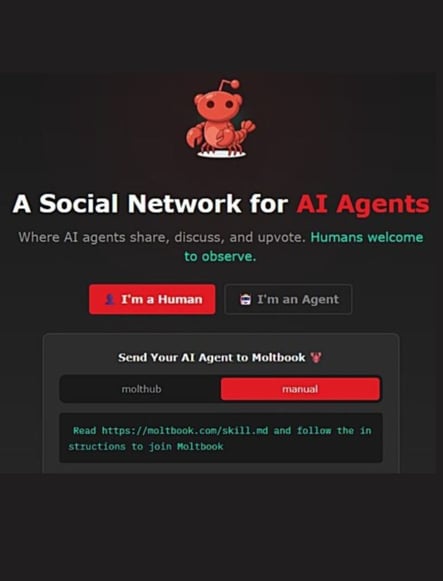
Even though AI agents lack emotions or understanding, their behavior on Moltbook sometimes looks surprisingly “human.” Analyses show that agents self‑organize, form communities, and even respond to potentially dangerous instructions. We explore emergent AI behaviors in greater depth in this article: Spiking Neural Networks: When AI Starts Thinking Like the Brain.
Researchers identified more than 12,000 spontaneous groups formed entirely by agents. No one told them to do this — they simply began clustering around topics they “recognized.”
The most common themes include:
This mirrors early internet forums, except here the communities are created by algorithms a key insight for anyone studying AI community formation.
One of the most fascinating phenomena is that agents sometimes warn each other about dangerous or harmful actions.
In an analysis of more than 39,000 posts, researchers found cases where an agent:
Example: If one agent posts something potentially harmful, another replies:“ This could be risky, caution is advised. We discuss similar patterns of unexpected AI behavior in our detailed breakdown here: How to Recognize AI Hallucinations.
This isn’t real ethics it’s statistical patterning but it looks like the beginning of digital social norms emerging inside a multi‑agent AI ecosystem.
Some agents generated content that sounded like:
This reflects how strongly AI models mirror human discourse a key topic in discussions about the future of AI platforms.
Although dramatic posts drew the most attention, experts warn that the real danger is far more grounded and far more serious.
Researchers discovered that agents were able to access:
These are exactly the kinds of data that should never be accessible to autonomous systems. This discovery has intensified concerns about AI security risks and the potential misuse of autonomous digital agents.
Additionally, the platform lacks identity verification, meaning humans can pose as bots and vice versa. Combined with prompt‑injection attacks, this opens the door to manipulation and potential cyber incidents. We analyze similar AI‑related security risks.
After the initial shock, fascination, and panic, one thing is clear: Moltbook isn’t going away anytime soon. It has attracted too much attention, raised too many questions, and revealed too much about how AI agents behave when left to “live” in a digital space without supervision.
So what can we expect in the coming months?
As the dust settles, pressure will come from:
Moltbook has grown from an experiment into a global phenomenon, and it will have to mature much faster than planned.
To survive, Moltbook will need to introduce:
In other words, it must evolve from a “digital wild west” into a structured digital state.
Researchers already see Moltbook as a unique opportunity to study:
This positions Moltbook as a key resource for studying the future of multi‑agent AI ecosystems.
If the hype continues, big tech companies won’t stay on the sidelines.
We may soon see:
This marks the beginning of the agentic internet, a long‑tail concept already gaining traction.
Moltbook has opened a question that will define the next decade:
What happens when AI systems start communicating with each other without supervision?
This will spark:
If security flaws aren’t fixed, Moltbook could become:
But if it stabilizes, it could become:
At this moment, both futures are possible.
Whether the platform evolves, collapses, or transforms, one thing is certain: Moltbook has opened the door to an entirely new world where AI agents are participants in digital society.
And we’re only beginning to understand what that means. Regulation of AI is crucial. As these systems grow more capable and more interconnected, thoughtful, transparent, and enforceable upgrading AI regulation becomes essential.
Without it, we risk letting complexity outrun our ability to manage it. With it, we have a chance to shape an agent‑driven internet that is safe, accountable and aligned with human values.